

PSVALUETALKS 2025: CONCLUSIONS
Culture, new economic models and artificial intelligence
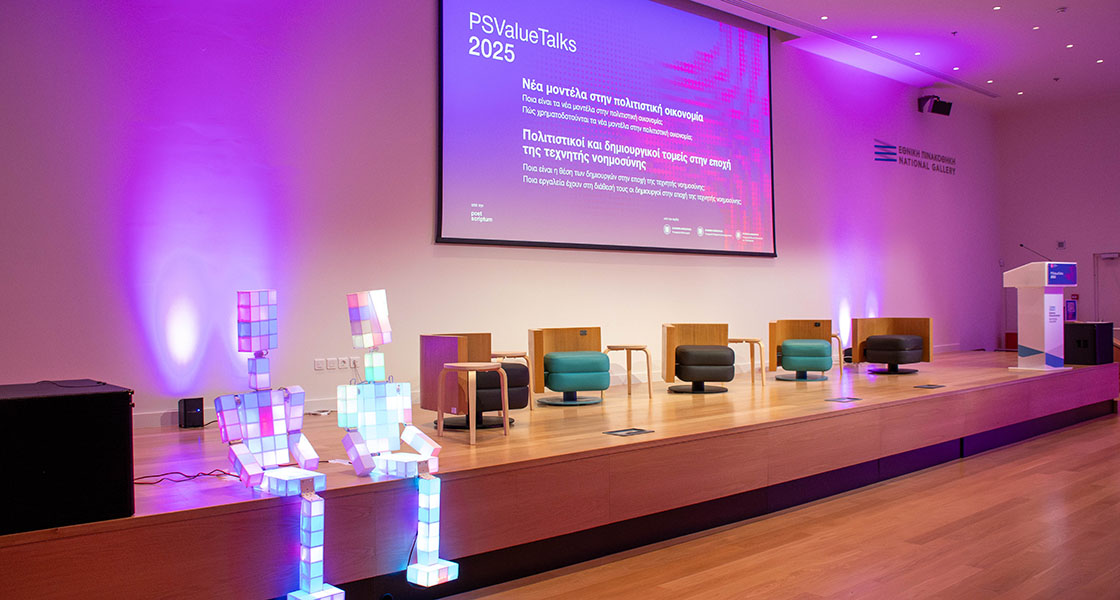
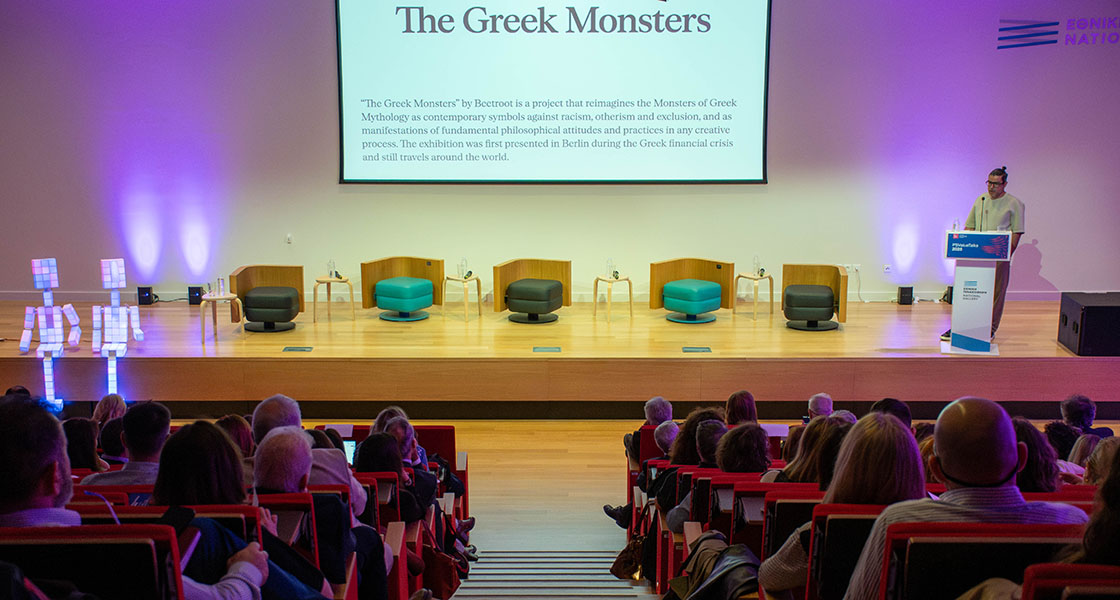
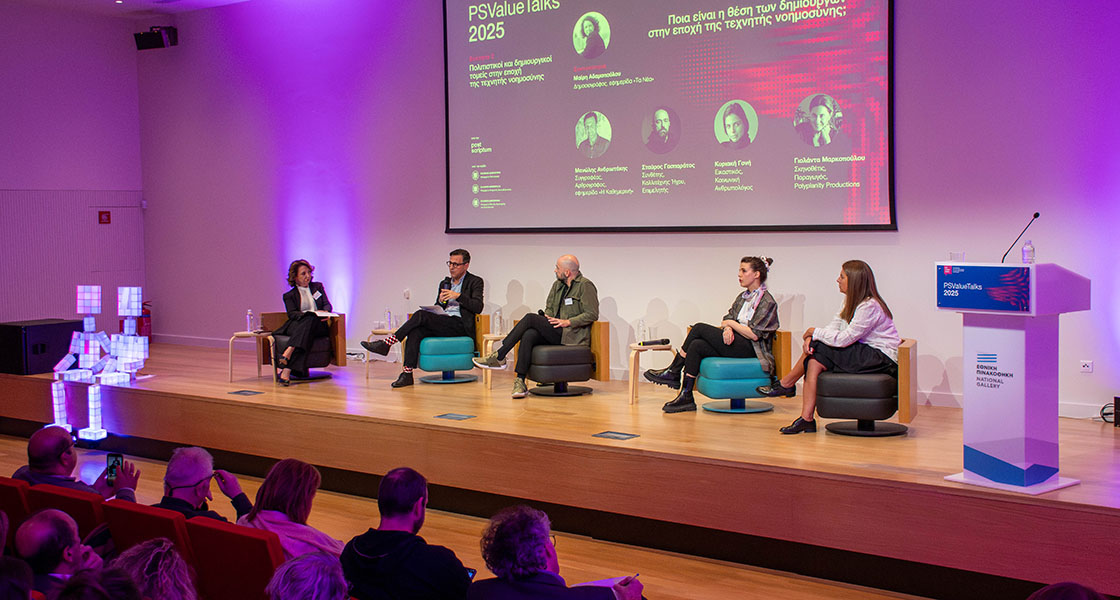
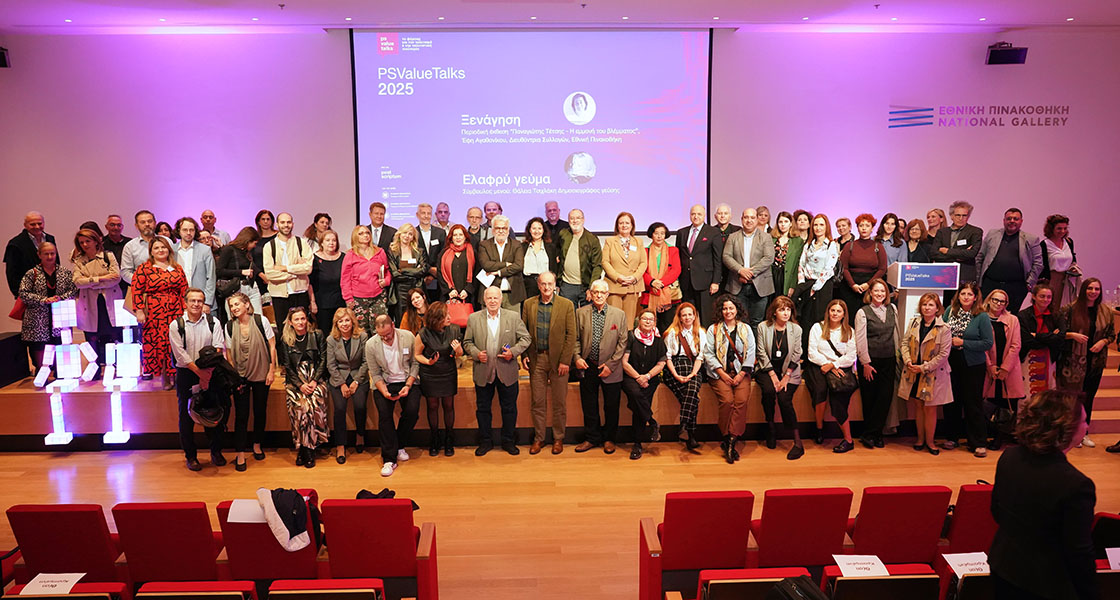
PSValueTalks (PSVT) 2025, the leading forum in Greece for culture and the cultural economy, organised by PostScriptum, took place, under the auspices of the Ministries of Culture, Economy and Finance, and Digital Governance, on Tuesday 11 November at the National Gallery. The Forum, featuring 2 thematic sections, 4 panels, 2 round tables and more than 60 speakers, attracted strong interest from representatives of the quadruple helix, spanning academia, the business community, government and civil society.
PSValueTalks 2025 successfully highlighted Greek entrepreneurial ventures centred on culture, while also focusing on the need to develop new, sustainable financing tools for cultural economy models. Emphasis was placed on public-private partnerships, the education and empowerment of stakeholders, support for smaller creative actors, as well as the adaptation of the institutional framework so that it effectively supports cultural entrepreneurship.
Discussions around Artificial Intelligence (AI) brought to the fore both the strong concerns and the justified ambivalence of creators, without overlooking the significant opportunities arising from new technologies. Key issues included intellectual property rights, the quality and authenticity of creative output, the reliability of data, as well as the risk of reproducing social stereotypes through the unregulated use of AI.
The Minister of Culture, Lina Mendoni, and the Minister of Economy and Finance, Kyriakos Pierrakakis, in their opening remarks, underlined that PSValueTalks highlight critical themes that lie at the core of government strategies, as they focus on heritage preservation, infrastructure development, the integration with tourism and the strengthening of the creative industries for balanced regional development. It was also noted that culture constitutes an investment in the future and a driver of development. In the new digital era, the challenge is to enhance creativity through AI rather than replace it – something which, of course, requires the establishment of new rules and balances.
Specifically
The first section of the Forum, entitled “New models in the cultural economy”, explored the challenges and opportunities in cultural business models and financing. Among other things, the following were identified:
● Traditional financing (sponsorships, state subsidies) is becoming increasingly precarious. The cultural sector is called upon to innovate in its business models by developing multiple revenue streams and new forms of value creation.
● Supporting those working in culture in adopting new business models is considered imperative, as is the utilisation of skills derived from culture (critical thinking, creativity) to strengthen entrepreneurship overall.
● The key to economic sustainability lies in a high level of artistic curation combined with business synergies, with the aim of functioning as multipliers of social and economic value.
● Impact investing was presented as an interesting example of a “middle ground” between traditional investments and donations.
● Nevertheless, public funding continues to be considered extremely important, as, by consensus, art and culture should be treated as public goods. However, the need to redefine funding policies was highlighted so that they better reflect the particularities of the cultural sector.
From the discussion among speakers in the two panels of the first section, important findings also emerged that require further exploration:
● A lack of sufficiently strong partnerships between the private and public sectors to produce cultural and social capital was identified.
● Limited implementation of alternative financing models in Greece was observed, despite the existence of relevant expertise and innovative ideas.
● It was pointed out that new financing models encounter difficulties when applied to sectors that are not closely connected to the market.
The second section, entitled “Cultural and creative sectors in the age of artificial intelligence”, focused on AI, its applications, the risks involved and the existing legal framework. The key conclusions are summarised as follows:
● AI, particularly within the creative community, generates strong feelings of concern, ambivalence and uncertainty.
● It was characterised as a technology of control, with concerns focusing on the risk of human automation and the concentration of power in the hands of “techno-feudal” actors.
● The main risks are identified as job displacement, the infringement of intellectual property rights, algorithmic bias and the “photocopy phenomenon” (model collapse), whereby AI models are trained on data produced by other AI models, resulting in degraded quality and the production of homogeneous and inaccurate outputs.
● The importance of properly understanding the legal framework was emphasised, as was the significance of the form and degree of human–AI interaction. The use of AI tools could be classified into three levels: a) the production of a “ready-made” output with responsibility attributed to the algorithm; b) the use of AI as an assistant, with substantial human intervention; and c) the development of a proprietary AI model. As human involvement increases, the legal and ethical recognition of the creator is strengthened.
● The need for the formulation of a national strategy was underlined, which would include, indicatively, the development of a Greek large language model (LLM) trained exclusively on Greek data, the creation of data spaces for the Greek language and culture, as well as free access to infrastructure (such as the “Daedalus” supercomputer) for researchers, start-ups and small and medium-sized enterprises.
In conclusion
PSValueTalks 2025 highlighted the critical issues concerning the cultural and creative sectors, as well as the cultural economy more broadly, considering developments in Artificial Intelligence.
It was confirmed that creators should orient themselves towards finding new ways to generate financial value from their work. At the same time, both the absence of strong partnerships between the public and private sectors and the limited implementation of successful financing models, particularly in non-commercial sectors, were observed.
A shared acknowledgement was that culture requires both stable public support and meaningful cross-sector collaboration. The active participation of artists at all stages of dialogue and design was considered decisive for shaping fair, effective and human-centred solutions. By general agreement, AI was recognised as an integral dimension of contemporary cultural production. However, particular emphasis was placed on the uncertainty and sense of risk it creates among stakeholders.
Finally, the speakers emphasised the importance of PSValueTalks as a platform for dialogue, as well as its significant contribution to public discourse on the future of the cultural and creative sectors. The aim of the Forum is to function as a catalyst for further research, collaboration and discussion, with the ultimate objective of shaping policies and strategies for the benefit of culture, the economy and society.
OTHER NEWS

Athens Music Week
Aikaterini Laskaridis Foundation
From the Aegean to the Ionian: A Sea of Knowledge

WikiEllinisti: A New Initiative to Strengthen the Greek Presence on Wikipedia

WOMCOM Joins Athens Music Week 2024
WOMCOM participates in Athens Music Week 2024 with a diverse program
OTHER NEWS